|
|
|
Different single-ended amplifiers.
A couple of low-wattage simple instrument amplifiers with all kinds of odd features.
Contents:
Les Paul Junior with loctal tubes
Champ with 6C8G preamp
Amazokal (Kalamazoo Model One)
A small preface: SE guitar amplifiers, like Fender Champ and others, are the most simple DIY tube projects you may find. In addition, they sound awesome and tend to be surprisingly loud for their 5W rating. I've made a couple of those with unusual tubes and other funny "upgrades" and this page is dedicated to them.
Les Paul Junior
One day I was staring at broken radios at the local second-hand shop and noticed an ugly wreck. It was so bad it would be impossible to restore it, so it was a chance for me to use it for some project. The closer inspection revealed a broken field-coil speaker, loktal tubes and insane amount of dust. I bought it for about $15 and brought home.
It was a big old Douglas radio, the speaker was dated 1947. The power transformer looked fat and was marked 360-0-360. The output tube was one 7C5 which is a 6V6 equivalent with loktal base. The rectifier tube looked very dirty and used. The labelling has evaporated so I've had no idea what it was, it was fed off the 5V transformer's secondary via some strange-looking spring. The tube lineup was the following: 7C6, 7B7, 7S7, 7C5 and what was finally identified as AZ41 rectifier. AZ41 is a 4V tube and the spring was actually a resistor. 7C5 is a loctal version of 6V6. 7B7 is a RF pentode and 7C6 contains one triode section. The idea was to use the rusty chassis, the sockets and the tubes. One 7B7 pentode and one output 7C5 were sufficient for an early Champ/Les Paul Junior type circuit and I wasn't sure if the transformer may handle more than this.

The rusty transformer.
I've taken the Gibson Les Paul Junior circuit and changed the tubes. First, the old AZ41 rectifier with that spring was looking bad so I've replaced it with the loktal 5AZ4. The output tube was okay. Input pentode section was bothering me a bit because it was a RF pentode. I've decided to make two preamp channels - one with "conventional" 6SJ7 and another with 7B7. Here's the final scheme:

The resistors in the power supply before the A+ are to drop the voltage which gets too high (around 505V). When I'll get some OC3 - OC4 discharge tubes I'll probably drop them in instead of the resistors. As you can see, the preamp channels may work in parallel mode and that's what I usually do.

This is the chassis with new filter caps, and all the tubes except 7B7 (the metal 6SJ7 hides behind the output transformer, two tubes on the front are 7C5 (left) and 5AZ4 next to the power tranny.
The amp sounds just like a regular pentode-input Champ should - not too distorted, bright and vintage sound. There's a very little difference between two different pentodes. I've put the same resistors' and capacitors on both tubes and this probably contributes to the similarity. Closing the jumper switch puts the channels in parallel which fattens up the sound without adding distortion. I keep the switch closed almost all the time because single pentode sounds much less interesting.
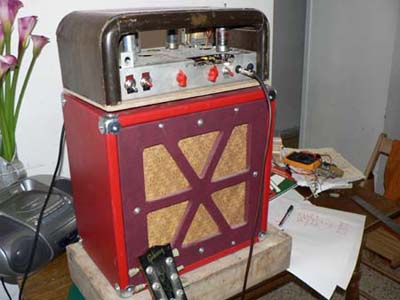
The amplifier sits in an original radio enclosure (I've cut the height in a half).
6C8G + 7C5 SE amplifier
6C8G is a medium-mu double triode with a grid cap and an octal base. It was used in the 30's - 40's for phase inversion and audio amplification stages. I have to say I love the look of 6C8G, it's very sexy. This was probably the main reason for using this tube (the other reason is that it's cheap, around $3-$5).
The output is 7C5, which is a loctal equivalent of 6V6. Again, it has a weird base, weird look, and they are much cheaper than 6V6, so you can get a $5 NOS RCA. Just what I love.
Here's the scheme, it's once again based on the Champ concept with appropriate changes in the preamp section components' values.

The amplifier works good, but it's pretty far from Champ. I'm not sure 6C8G is a "guitar" tube, it's pretty clean and when pushed into distortion zone it becomes less attractive than 12AX7. Or maybe I've biased it too hot. I needed this amplifier for clean sounds on a less than 5W volume, so it serves me fine, but I won't recommend this for guitar amp.
Amazokal = Kalamazoo Model One clone.
I've got a 1966 Kalamazoo Model One amplifier which I've bought as a chassis only, repaired it and made a head out of it. The complimenting speaker is Celestion Century 12". Kalamazoo is a very nice amp with a simple circuit. Here's my repaired Kalamazoo with a custom 12" speaker cab and my black woofer:

At some stage I wanted to clone it. I've had a destroyed and burned (exploded filter cap) child patephone from the 60's which used 6AV6, EZ80 and EL84. The tube lineup is pretty similar to the Kalamazoo's which uses 12AX7, 6BQ5 and 6X4. When I took the power transformer out of the patephone it looked strange. After a short investigation the secondary wiring was identified as 250-0-6.3 (only one 261.3V coil with 6.3V tap) - The EZ80 rectifier had both cathodes wired to the 250V tap, which means it was only a half wave rectification. I've seen similar transformers in many EL84/ECL82/ECL86-powered European mono patephones made around 1965-1970. So here's the scheme of my clone -

The most interesting part is probably the power supply with it's half-wave rectification, you won't find it in books, only in the real world. The rest of the circuit is the classic Kalamazoo Model One.
|
|
Warning!
You've read it before, but I have to repeat it. Working with tubes is dangerous, tube amplifiers work with lethal voltages that may kill you. I think everyone who ever worked with tubes was electrified at least once. I was lucky and stayed alive, but the majority of the world population died during the 30's - 50's because of the tube equipment shocking hazards. While it may seem funky and look cute, these tubes are fatal.
The best part about it are the power supply filter capacitors. Those big cans, you know. After you unplugged everything and went to have a lunch, the lethal charge is stored inside those cans, and you will be surprised to find out how hard they bite.
So please, keep one hand in your pocket, discharge the power supply caps, don't try this at home and stay away.
The healthy alternative to those mortal projects are low voltage tubes. You can check out my Space Charger amplifier and ECH83 preamp projects that not only simple and cheap, but they're actually safe to work on.
I warned you.
|
|


