|
|
|
Space Charger amplifier
A guitar amp with with 12V power supply, cheap parts and bedroom output level. A great beginner's project - simple circuit, cheap parts and no high voltages. Easier than a champ!
Download the PDF schematics here.
Download the sound files here.
Download the RCA tube porn here.
Contents:
Pros and Cons at messing with the Space Charge tubes
Space charge tubes with datasheets
Scheme
Parts
Sound samples

This project started as an investigation of the space-charge tubes' world. For those of you who don't know what those are, here's a bit of historical background:
Space charge tubes were introduced somewhere in the 50's. They were intended to be used in car audio, powered by the car's 12V power supply. They plate voltages do not exeed 30V.
Surprisingly - NOT - output Space Charge tubes cannot compete with regular hi-voltage tubes in terms of output volume. Average output spacecharge tetrode delivers 0.1-0.4W in single-ended operation which is nothing compared to 4-5W of low wattage EL84/6V6 that everyone uses. Still you can build an amplifier with all the regular stages.
The advantages of Space Charge tubes are:
No big, expensive and heavy power transformers (just a 12V needed)
No big, expensive and heavy output transformers (any cheap line OT works)
They're still cheap!
Space Charge tubes are really ODD.
For me, the last reason was probably the most important, but, generally speaking, it's a great, simple beginner project with cheap parts and the result might become the amplifier you play all the time - because it's so quiet. Since I've made my SpaceCharger, it's the only amp I play at home and record with.
The tubes
I've chosen only the cheapest tubes in $0.80-$2.00 price range. The price was correct for 2006 when I've bought them, today they might cost more. The other criteria was to find tubes noone used before in guitar amplification. Some tubes had the same pinout and I've ordered them to make it to allow swapping. Each tube had diodes in addition to the "main" section. So many diodes! I wish I could use them for something. Anyways, the diodes left unwired and I refer to triode and tetrode sections only. Here's what I've got:
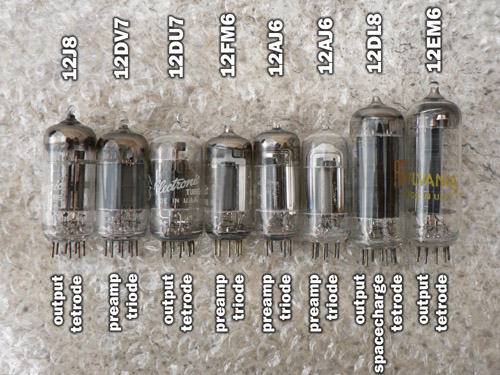
I've purchased the tubes from Antique Electronics and was very pleased to see black plates, RCA logos and other nice features not usually seen on $0.80 tubes. The list is:
Preamp tubes:
12DV7 - triode + dual diode, amplfication factor = 14
12FM6 - triode + dual diode, amplfication factor = 10
12AJ6 - triode + dual diode, amplfication factor = 55
Power tubes:
12DL8 - space-charge grid tetrode + dual diode, output = 0.4W
12EM6 - tetrode + diode, output = 0.1W
12DU7 - tetrode + dual diode, output = 0.25W
12J8 - tetrode + dual diode, output = 0.2W
(click on the tube's name to open the datasheet)
The circuit design:

Parts:
First, the transformers: The power transformer should have been a 12V to deliver both filament and plate voltages. I've bought a new 4A fluorescent light tranny for around $10. It had a cheesy-cool GRUNDING label and also looked unlike tube transformer, which is also a bonus. For the output I wanted to use some line transformers (with no gap) I've bought for about $5 each. They didn't have a center tap so the amplifier should have been single ended. I still wanted to put at least two output tubes in parallel. I also had huge 60,000uF/50V electrolytic caps from UPS power supply wreck - what a great thing for filtering! That was about purchasing expensive parts.
Power supply:
I just took a diode bridge, then my huge filter cap and a 12V/3A voltage regulator. At first I've thought to use the B+ from the first filtering stage before the regulator - to get higher voltage. Unfortnately, even 60,000uF was not enough to get rid of all the hum, so both filaments and plate voltage come from the voltage regulator.
Circuit design notes:
For some reason, all the Space Charge tubes were designed to work in grid-bias mode. Some people tried cathode-biased designs but reported it sounded less "open" than grid-bias. So i went for the grid bias and this saved me a couple of resistors and caps.
In order to get noise to the minimum I wanted the first preamp stage to be a hi-mu triode which is 12AJ6. Fortunately, 12AJ6's datasheet specified 1M load resistor, grid bias resistor and also input and output coupling caps. For the next preamp stage I wanted something different so it became 12DV7 . The datasheet had no info on load resistor so I've used a potentiometer to find the optimal value. For the output I wanted to use the most powerfull tube - the 12DL8 (40mW!!!). The first version of the Space charger had two output 12DL8's in parallel.
From the very beginning I eliminated the volume knob and I don't regret. Just plug and play, who needs knobs!
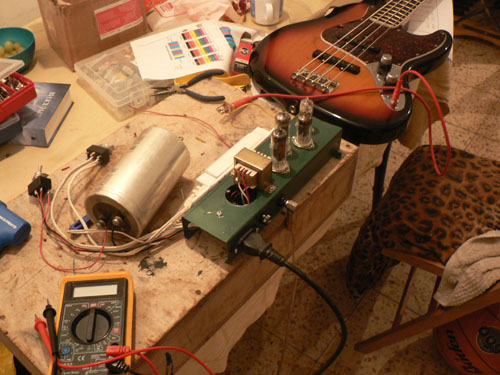
Early stages: note the electrolytic can and the power transformer attached to the side of the chassis. And, of course, note my beautiful '62 JazzBass.
Everything worked, but when I pulled off one of the output tubes the sound cleand up and became less saggy. Two 12DL8's sucked so much filament current it was dropping the whole B+ so I've rewired one of the sockets to accept a different output tube and left only one 12DL8. Also 12AJ6 could be swapped with 12FM6 which has the same pinout. It lowers the output volume, but the sound gets much cleaner. Maybe two 12FM6 might be better than one 12AJ6.
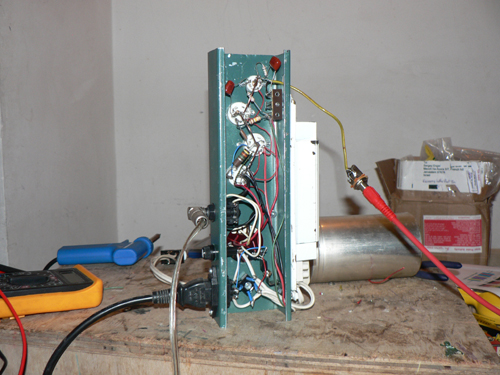
There were not too many components in the chain so I wired everything point-to-point and used only one terminal strip. Here's the insides of the chassis:
Everthing was fitted in a wonderful cabinet I've built. I've made it a combo using a small speaker from a 60's turntable wreck. The 4" speaker had 8Ohm/5W rating and was used in a SE amp with one EL84 output. I've tried many small speakers and most of them sounded bad. The dark side of the amp features the AC socket and an external speaker jack. If you plug the cord into the speaker jack it disconnects the internal speaker. The amp sounds much louder and bassier with 12" but still pretty quiet for a bedroom.
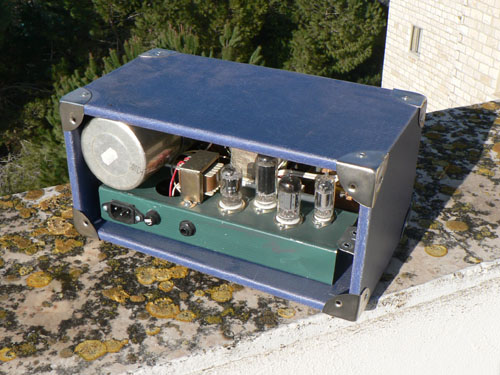
Tubes - left to right: 12DU7, 12DL8, 12DV7, 12AJ6. I was able to run two different output tubes in parallel, which caused slight chorusing and fattened everything up. Nice, I like!
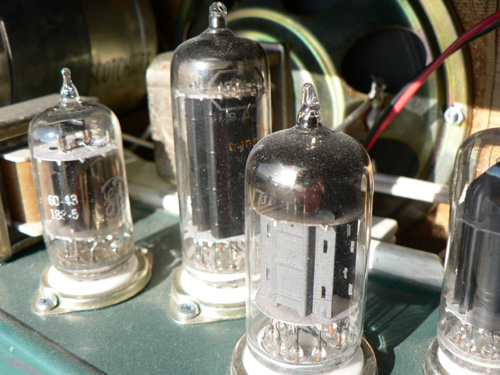
Below you see 12DL8 running in parallel with 12EM6. (left to right: 12EM6, 12DL8, 12DV7, 12FM6). 12DL8 eats 550mA of filament and 12EM6 eats 500mA of filament. The poor 3A voltage regulator cannot handle 1.7A of the total current and sometimes shuts up. One of the possible solutions migh be to put two 3A regulators in parallel but I haven't tried that.

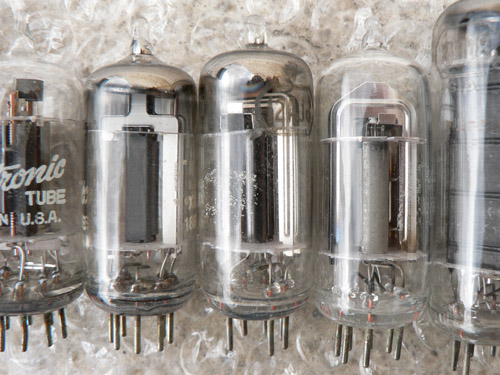
The preamp tubes preform well but for some reason they don't sound too hi-fi. I've listened to the preamp only and it cuts some of high frequencies. It might as well be the capacitors in the chain, I'm not sure. The resulting sound is very pleasing so I've left it like that. It's more like a germanium transistor that gives everything a nice vintage flavour. Here you can see the closeup of the 7-pin preamp tubes. Left to right: 12FM6 General Electric, 12AJ6 General Electric, 12AJ6 RCA. The inner structure is very similar, the only thing that looked strange to me was a RCA 12AJ6 getter (tube on the right): the glass is clean on the top and the ugly getter is on the side (not seen on the picture), while the GE tube has a regular silver spot on the top. Strange! At first I even thought the tube was used and the bulb was broken.
Sound files:
I was planning to record it with different output and preamp tubes, but I'm too lazy to do it right now. I'm playing the amp for already five years with the following tube lineup: 12AJ6, 12DV7 and 12DU7 output. The reason it sounds the best with only one output tube is probably the primary resistance of the OT which is better suited for one 12DU7 than two tubes in parallel.
So please wait and I will post some mp3's here later.
That's all, folks!
|
|
This project would still be incomplete without
Sopht amps - the greatest Spacecharge resource on the net
PRR - the man who always answers my questions at forums.
Antique Electronics Supply - with their seductive reductions.
|
|


